Why Saving Up Six Tiny Household Repairs Can Make More Sense Than Tackling Them One at a Time
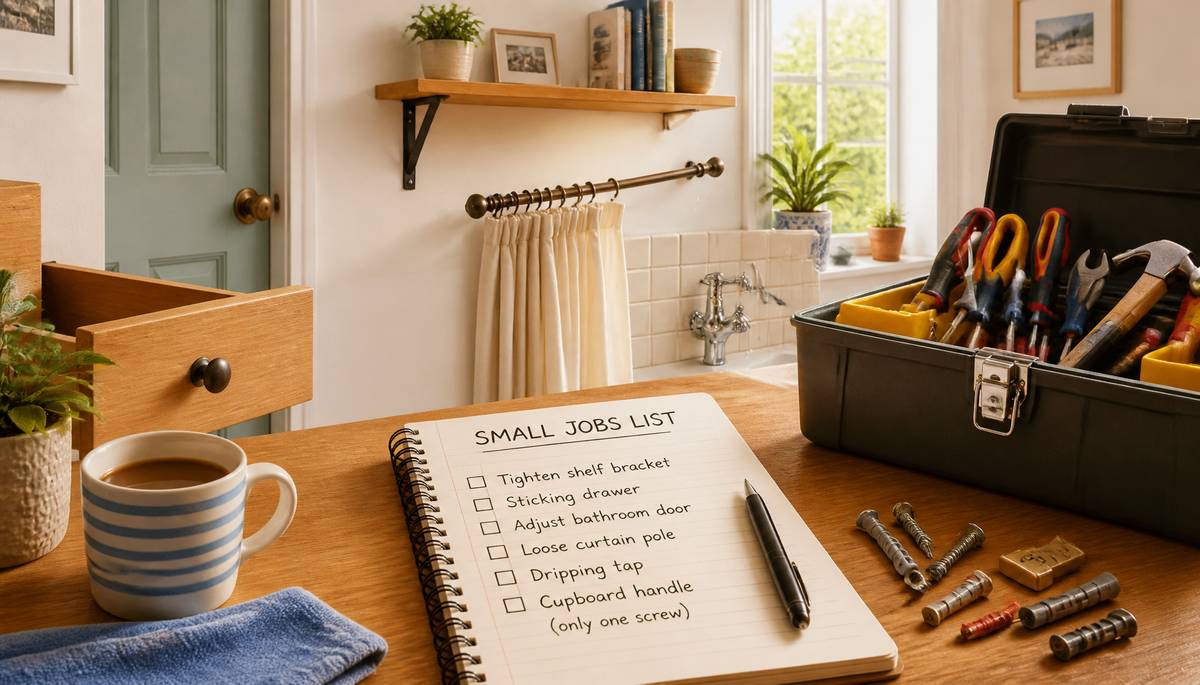 A loose shelf has an extraordinary ability to remain loose for six months without actually falling down. It simply develops a slight downward lean, enough to be noticed but apparently not enough to justify fetching the toolbox. Soon it has company: a drawer that needs an encouraging shove, a curtain pole with questionable ambitions and a tap performing its own slow percussion solo.
Most homes accumulate these tiny maintenance jobs. Individually, none seems particularly urgent. Collectively, however, they can make a perfectly decent home feel slightly neglected. One practical answer is surprisingly simple: stop treating every small repair as a separate event and start keeping a small jobs list.
Why Tiny Jobs Have Remarkably Long Lives
Minor household problems occupy an awkward territory between “needs fixing” and “can wait.” A broken boiler demands action. A kitchen drawer that sticks every third Tuesday does not. Consequently, people adapt. They learn that the drawer needs lifting slightly before pulling, that the bedroom door closes if pushed with a hip, and that nobody should put anything heavier than a paperback on the left side of the shelf.
This adaptation is convenient, but it also allows minor faults to become permanent residents. After a while, nobody even remembers that the cupboard handle is supposed to have two screws.
Keeping a written list changes that. Instead of relying on the momentary irritation generated by a problem, add it to a household maintenance list. Once five or six jobs have accumulated, there is enough work to justify setting aside a morning, arranging professional help where necessary, or finally opening the toolbox without feeling that twenty minutes of preparation is being devoted to tightening one hinge.
One Disruption Instead of Six
Even a tiny repair creates overhead. Tools have to be found, furniture moved, dust sheets fetched, replacement parts bought and mysterious containers of assorted screws inspected. If somebody is being brought in to do the work, there is also the inconvenience of arranging access and being available.
Grouping jobs reduces that repetition. A loose curtain pole, misaligned door, wobbly shelf and sticking drawer may require completely different repairs, but they can still be inspected during the same session. Necessary parts can then be identified together and the work approached systematically.
This is particularly useful when using a handyman or other maintenance professional. Calling someone out repeatedly for very small tasks may be inefficient, whereas presenting a sensible collection of jobs allows the visit to accomplish considerably more. It also provides an opportunity to mention those peculiar little problems that have become part of domestic folklore: “That handle does come off, but only when Uncle Martin uses it.”
Small Faults Sometimes Grow Teeth
There is an important distinction between batching non-urgent maintenance and ignoring developing problems. A dripping tap may worsen and waste water. A loose shelf fixing can gradually damage plasterboard. A door rubbing against its frame may simply need adjustment, but a sudden significant change can occasionally indicate a broader issue worth investigating.
Leaks, electrical faults, signs of structural movement and anything presenting an immediate safety risk should not sit patiently on a six-item list awaiting company. Those deserve prompt attention. The batching approach is intended for genuinely minor maintenance: the irritating, non-emergency jobs that otherwise have a habit of surviving until the next owner moves in.
A Periodic Inspection Beats Waiting for Annoyance
There is another advantage to the small jobs list: it encourages inspection rather than reaction. Once every few months, walk through the home specifically looking for minor maintenance issues. Check shelves and brackets, open awkward drawers, test handles, look at sealant around wet areas and pay attention to doors that have started behaving as though they require individual negotiation.
This does not need to become a clipboard-and-hard-hat operation. Ten minutes is often enough. The point is simply to notice deterioration before familiarity makes it invisible. Humans are remarkably good at accepting small inconveniences. Give us three weeks with a cupboard that only opens when kicked gently near the bottom and we will start regarding that technique as part of the cupboard's design.
A periodic check can also reveal related problems. Several loose fittings might indicate that particular fixings were unsuitable when originally installed. Multiple sticking doors appearing during humid weather could suggest seasonal timber movement rather than six unrelated faults. Looking at the home as a whole can therefore provide useful context that is easily missed when every problem is treated separately.
Keep the List Useful Rather Than Heroic
A maintenance list works best when it remains specific. “Sort out house” is not a job; it is a threat. “Tighten dining-room shelf bracket” is manageable. “Adjust sticking bathroom door” tells you exactly what needs attention.
It can also help to note anything unusual beside each item. If the tap only drips after being turned off firmly, write that down. If the drawer sticks mainly during damp weather, record it. If the curtain pole has become progressively looser rather than suddenly moving, that information may help determine what repair is required.
There is no magic number, either. Six jobs makes a useful batch, but three substantial minor repairs might justify action while eight exceptionally trivial ones could wait. The aim is efficiency rather than obedience to an imaginary household maintenance constitution.
Fixing the Little Things Before They Become Furniture
Small repairs have an odd psychological effect. Individually they barely matter, yet encountering several of them every day can make a home feel less comfortable and less cared for. The dripping tap heard at midnight, the handle that rotates uselessly before catching and the door requiring a shoulder charge all impose tiny bits of friction.
Dealing with them together can produce a disproportionately satisfying result. Nothing dramatic has changed. There is no new kitchen to admire and nobody is inviting the neighbours round to witness the newly tightened curtain pole. Yet suddenly everything simply works as it should.
That is ultimately the value of the small jobs list. It turns household maintenance from a succession of irritating interruptions into an occasional planned session. Problems are noticed, recorded and dealt with in sensible batches, while genuinely urgent faults remain urgent.
And perhaps most importantly, the sticking drawer finally becomes just a drawer again, rather than a piece of furniture with whom everyone in the household has developed a complicated personal relationship.
|
|
